

Psychological safety is a shared belief that a team or group is safe for interpersonal risk-taking. Plainly put, it's the sense that 'we can share ideas, admit mistakes, and call things out, without being ignored, ridiculed, or punished.'
Google's Project Aristotle popularized it after naming it as a primary driver of their most innovative teams (Google re:Work). Dr. Amy Edmondson initially studied it in healthcare, where she, paradoxically, found that the teams with higher psychological safety made more mistakes. Actually, they weren't making more mistakes. They were just talking about them openly (Edmondson, 1999).
I don't know about you, but I'd rather have my doctors admit their mistakes than hide them.
The Dangers of Not Having It
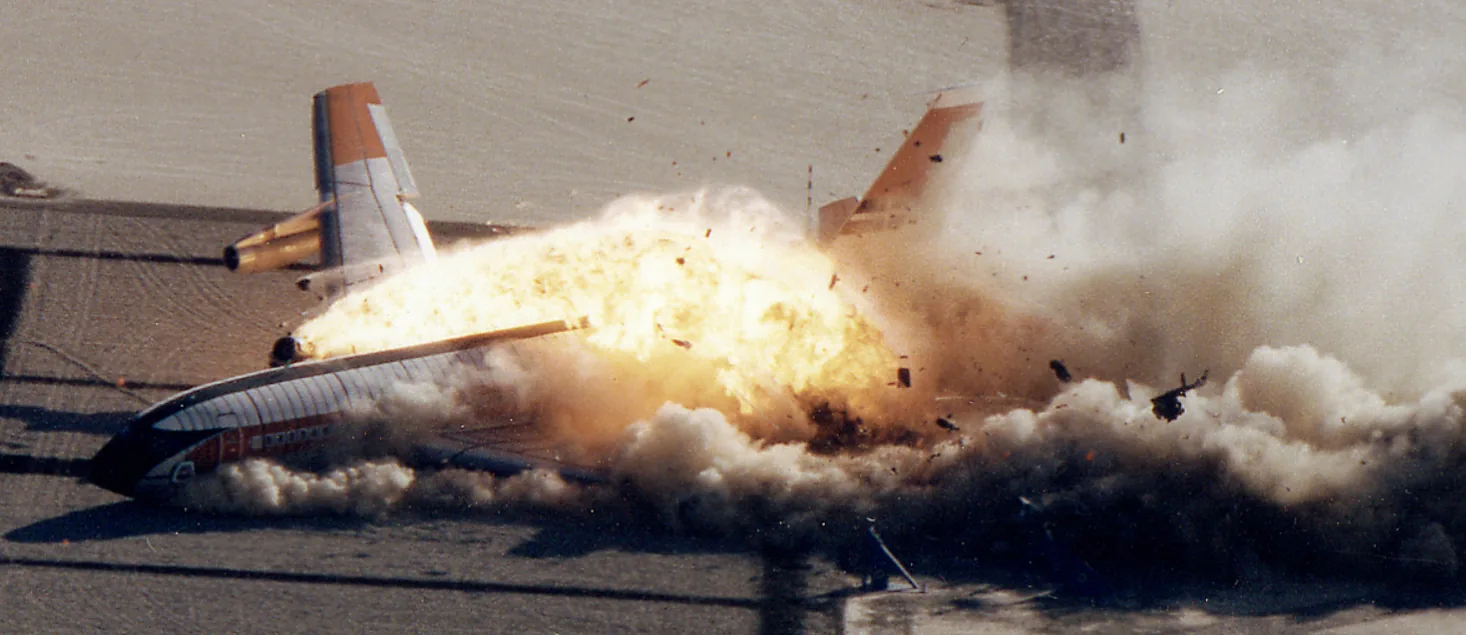
There are plenty of horror stories illustrating what happens when psych safety is missing. Take the 1986 Challenger Disaster for example (Rogers Commission, 1986). Engineers knew there was a critical and dangerous flaw. They tried to make the issue known, but NASA dismissed them. So, out of fear of retaliation and pressure to defer to their superiors, the engineers remained silent. All seven crew members died in the explosion during launch, which was also nationally televised for all to witness.
Other high-profile cases include the Tenerife Airport Disaster (1977) (Knopfholz et al., 2026)— a junior first officer and a flight engineer both doubted whether they were cleared for takeoff, but were silenced by the legendary status of the KLM captain. They crashed into another plane, killing 583.
The Space Shuttle Columbia (2003) disaster was anticipated by engineer Rodney Rocha (Columbia Accident Investigation Board, 2003). He pushed to investigate the issue, but was shut down by his superior. Despite his paralyzing concern, he didn't bring the issue up again during a pivotal meeting with the flight director. He later recounted… "I just couldn't do it [speak up]. She [his senior manager] was way up here [gestures with hand overhead] and I was way down here [gestures with low hand]."
What's the common trend?Cultures of concealment to save face, unquestionable authority, and obsession with speed and profitability over safety (especially evident in the Boeing 737 MAX Crashes (2018-2019) (Naor et al., 2020)).
Low psych safety also makes it harder to admit one's own mistakes. In healthcare, the moral imperative to admit errors is high. Even so, they go unreported constantly; 'fear of the consequences' is the biggest reason (e.g. Rutledge et al., 2018; Braiki et al., 2024). Fear of being blamed, labeled a troublemaker, facing their superiors and colleagues, and losing job security (Alfaifi et al., 2022). It might surprise some to realize that the factors that most predict who will admit mistakes aren't the character of the individual; it's an organizational culture that's non-punitive and learning-focused (Rutledge et al., 2018).
The Benefits It Brings
 ⤢ Click to enlarge
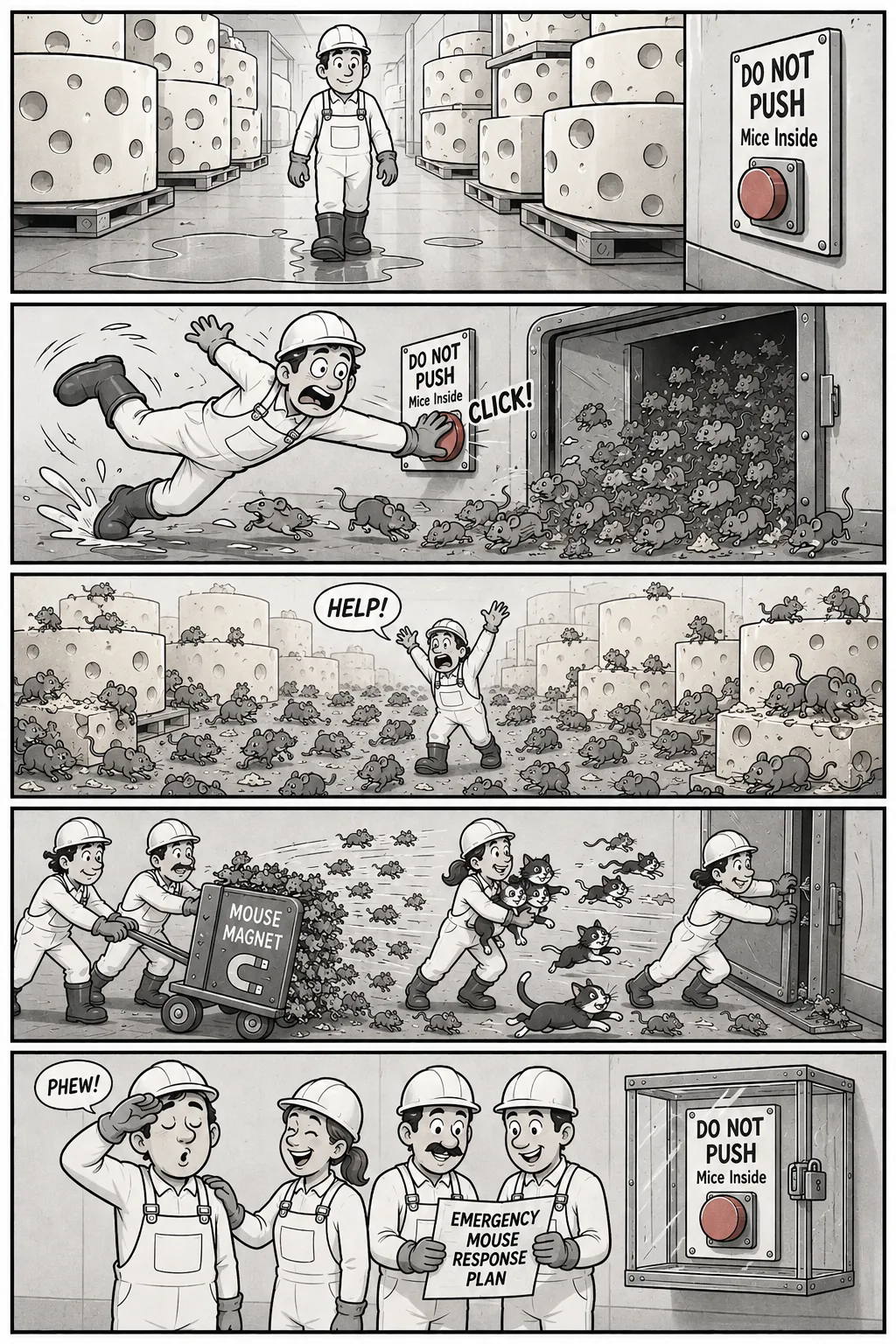
Cheese Factory made by chatgpt
Obviously, psych safety is important in jobs where lives are at stake. So, you may be asking whether it matters as much in other occupations. Indeed, psychological safety is not just for risk management; it's an engine of high performance and innovation.
Let's start with the most famous example. Google's Project Aristotle set out to find what made their best teams work, and found that psychological safety was the number one predictor of team effectiveness — ranked above dependability, structure, meaning, and impact (Google re:Work). In research of over 22,000 people, psychological safety was consistently linked to information sharing, learning behavior, engagement, task performance, commitment, and job satisfaction (Frazier et al., 2017).
Psychological safety leads to innovation. High-tech companies known for democratizing innovation (W.L. Gore, for example) normalize sharing half-formed ideas, and the outcome is a direct, positive effect on their innovative performance (Jin & Peng, 2024). When there isn't a social risk to speaking up or 'looking stupid', knowledge moves more freely between people; this is where innovations come from. On the flip side, when people withhold information (commonly dubbed 'knowledge hiding'), it drags down creativity, innovation performance, and one's potential to grow (Connelly et al., 2012; Jiang, 2019).
Psychological safety raised the odds of an employee adopting AI tools by about 30% (Wolfe et al., 2026). This indicates openness to adapting and potentially exposing one's own skill gaps.
Psychologically safe workplaces are ones that employees don't want to leave, having clear links to commitment and job satisfaction (Frazier et al., 2017). Skilled employees are costly to replace (as high as 50–200% of their annual salary), and they take hard-won institutional knowledge with them (SHRM, 2024).
Psychological safety improves work-related mental health. BCG estimated that workplace-related mental health issues cost Canada more than $220 billion annually, $190 billion of which is due to absenteeism (BCG, 2023).
Psychological safety directly mitigates burnout. In a study of nurse practitioners, it measurably buffered the relationship between a strained work environment and burnout, cutting the effect on emotional exhaustion by around a third (Schlak et al., 2024). WHO-led analysis found roughly $4 returned for every $1 invested in scaling up depression and anxiety treatment (Chisholm et al., 2016).
So, why do we care about psych safety? Because not having it is costly, and having it is an incredible asset. Critical problems surface before they're too late to fix. Performance and innovation surge thanks to free-moving information. People feel supported and engaged in their workplaces and want to stay. The list goes on.
So what does psychological safety actually look like on a team? That's Chapter 2.
References
Alfaifi, [initials], et al. (2022). Knowledge and attitudes regarding medication errors among nurses: A cross-sectional study in major Jeddah hospitals.
Boston Consulting Group. (2023). [Report on the cost of workplace mental health in Canada].
Braiki, R., Douville, F., & Gagnon, M.-P. (2024). Factors influencing the reporting of medication errors and near misses among nurses: A systematic mixed methods review. International Journal of Nursing Practice, 30(5), e13299. https://doi.org/10.1111/ijn.13299
Chisholm, D., Sweeny, K., Sheehan, P., Rasmussen, B., Smit, F., Cuijpers, P., & Saxena, S. (2016). Scaling-up treatment of depression and anxiety: A global return on investment analysis. The Lancet Psychiatry, 3(5), 415–424. https://doi.org/10.1016/S2215-0366(16)30024-4
Columbia Accident Investigation Board. (2003). Columbia Accident Investigation Board report, Volume 1. National Aeronautics and Space Administration.
Connelly, C. E., Zweig, D., Webster, J., & Trougakos, J. P. (2012). Knowledge hiding in organizations. Journal of Organizational Behavior, 33(1), 64–88. https://doi.org/10.1002/job.737
Edmondson, A. C. (1999). Psychological safety and learning behavior in work teams. Administrative Science Quarterly, 44(2), 350–383. https://doi.org/10.2307/2666999
Frazier, M. L., Fainshmidt, S., Klinger, R. L., Pezeshkan, A., & Vracheva, V. (2017). Psychological safety: A meta-analytic review and extension. Personnel Psychology, 70(1), 113–165. https://doi.org/10.1111/peps.12183
Google re:Work. (n.d.). Guide: Understand team effectiveness. https://rework.withgoogle.com/intl/en/guides/understand-team-effectiveness
Jiang, Z. (Joe). (2019, November 14). Why withholding information at work won't give you an advantage. Harvard Business Review. https://hbr.org/2019/11/why-withholding-information-at-work-wont-give-you-an-advantage
Jin, H., & Peng, Y. (2024). The impact of team psychological safety on employee innovative performance: A study with communication behavior as a mediator variable. PLOS ONE, 19(10), e0306629. https://doi.org/10.1371/journal.pone.0306629
Knopfholz, J., Tempski, P., Karam, L. Z., Fogaça, L. B., & Martins, M. A. (2026). The Tenerife moment in health professions' education: A conceptual call to navigate uncertainty. Frontiers in Medicine, 13, 1752213. https://doi.org/10.3389/fmed.2026.1752213
Naor, M., Adler, N., Pinto, G. D., & Dumanis, A. (2020). Psychological safety in aviation new product development teams: Case study of 737 MAX airplane. Sustainability, 12(21), 8994. https://doi.org/10.3390/su12218994
Rogers Commission. (1986). Report of the Presidential Commission on the Space Shuttle Challenger Accident. National Aeronautics and Space Administration. https://sma.nasa.gov/SignificantIncidents/assets/rogers_commission_report.pdf
Rutledge, [initials], et al. (2018). Common barriers to reporting medical errors.
Schlak, A. E., Poghosyan, L., Rosa, W. E., et al. (2024). Psychological safety is associated with better work environment and lower levels of clinician burnout. Health Affairs Scholar, 2(7), qxae091. https://doi.org/10.1093/haschl/qxae091
Society for Human Resource Management. (2024). The real cost of employee turnover / cost-per-hire estimates.
Wolfe, D., Price, M., Choe, A., Kidd, F., & Wagner, H. (2026). Safety first: Psychological safety as the key to AI transformation. arXiv:2602.23279. https://arxiv.org/abs/2602.23279