
Part of the reason that psychological safety is such a strong construct is that we know when we don't have it. The feeling of having to walk on eggshells, hide your mistakes, watch what you say and how you say it… it's familiar to many of us.
What we choose to do in moments of interpersonal risk is heavily influenced by how our thoughts and feelings have been shaped by the psychologically (un)safe environment:
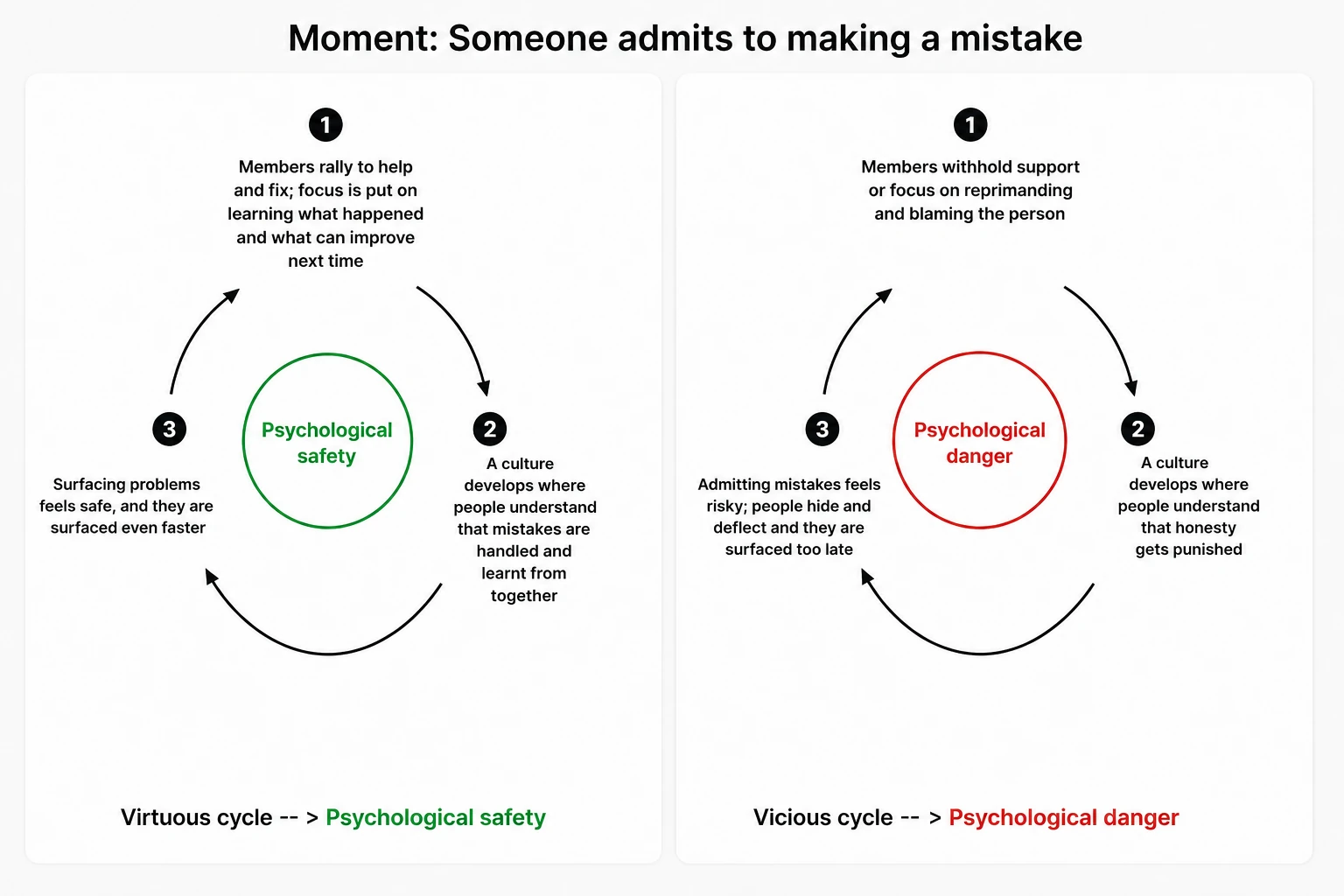
Psychologically safe environments depend heavily on how co-workers (and especially leaders!) react to what we do and say. If every time I ask an 'obvious' question, people roll their eyes or reprimand me for my ignorance, I probably won't keep asking. If I'm taken seriously and responded to with consideration, that will positively reinforce my question-asking behavior. Team and group behaviors either produce or reduce psychological safety through virtuous or vicious cycles.
 ⤢ Click to enlarge
Teams and organizations that value psych safety make concerted efforts to build it into their operations here are some examples…
- Toyota uses what they call an Andon Cord system, where any worker can stop the assembly line if they spot a mistake. They are met by co-workers' support and are given a sincere "thank you" for flagging the issue (Liker, 2004).
- Virginia Mason Medical Center implemented a Patient Safety Alert System, empowering any staff member, from surgeons to custodians, to immediately halt a medical procedure if they observe a potential safety concern. Instances like these are celebrated and investigated non-punitively (Furman & Caplan, 2007).
- Pixar instituted "Braintrust" sessions, where co-workers provide radical feedback on films in progress. The rule is that those giving feedback have zero authority to mandate change. It's purely advisory, which removes the need for directors to get defensive and for peers to speak without hedging their opinions to please a boss (Catmull, 2014).
- Under CEO Satya Nadella, Microsoft reframed its culture from "know-it-all" to "learn-it-all". They also removed forced ranking systems, which they saw as a killer of collaboration (Nadella, 2017).
- Google X rewards teams for finding ways to 'kill' their own projects. When they find evidence that their idea isn't working, they get rewarded highly (Edmondson, 2019).
- In high-stakes sectors like aviation, psychological safety is trained as a technical competency through Crew Resource Management (CRM) (Helmreich, Merritt, & Wilhelm, 1999).
Practices like these turn raising concerns into a vital duty, constructive dissent into a non-threatening practice, and admitting vulnerabilities into a personal strength.
So how do we actually build psychological safety in teams? Especially if teams are in states of stress or anxiety, distrusting and defensive, or stuck in other vicious cycles of toxic behavior. That's Chapter 3.
Sources
Catmull, E., with Wallace, A. (2014). Creativity, Inc.: Overcoming the unseen forces that stand in the way of true inspiration. Random House.
Edmondson, A. C. (2019). The fearless organization: Creating psychological safety in the workplace for learning, innovation, and growth. Wiley.
Furman, C., & Caplan, R. (2007). Applying the Toyota Production System: Using a patient safety alert system to reduce error. Joint Commission Journal on Quality and Patient Safety, 33(7), 376–386.
Helmreich, R. L., Merritt, A. C., & Wilhelm, J. A. (1999). The evolution of Crew Resource Management training in commercial aviation. The International Journal of Aviation Psychology, 9(1), 19–32.
Liker, J. K. (2004). The Toyota Way: 14 management principles from the world's greatest manufacturer. McGraw-Hill.
Nadella, S. (2017). Hit Refresh: The quest to rediscover Microsoft's soul and imagine a better future for everyone. HarperBusiness.