
The first step in building more psychological safety is getting an honest read on where your team currently stands. This provides essential insights and starting points for actively building or repairing it.
Determining the Team's Current Psychological Safety
 ⤢ Click to enlarge
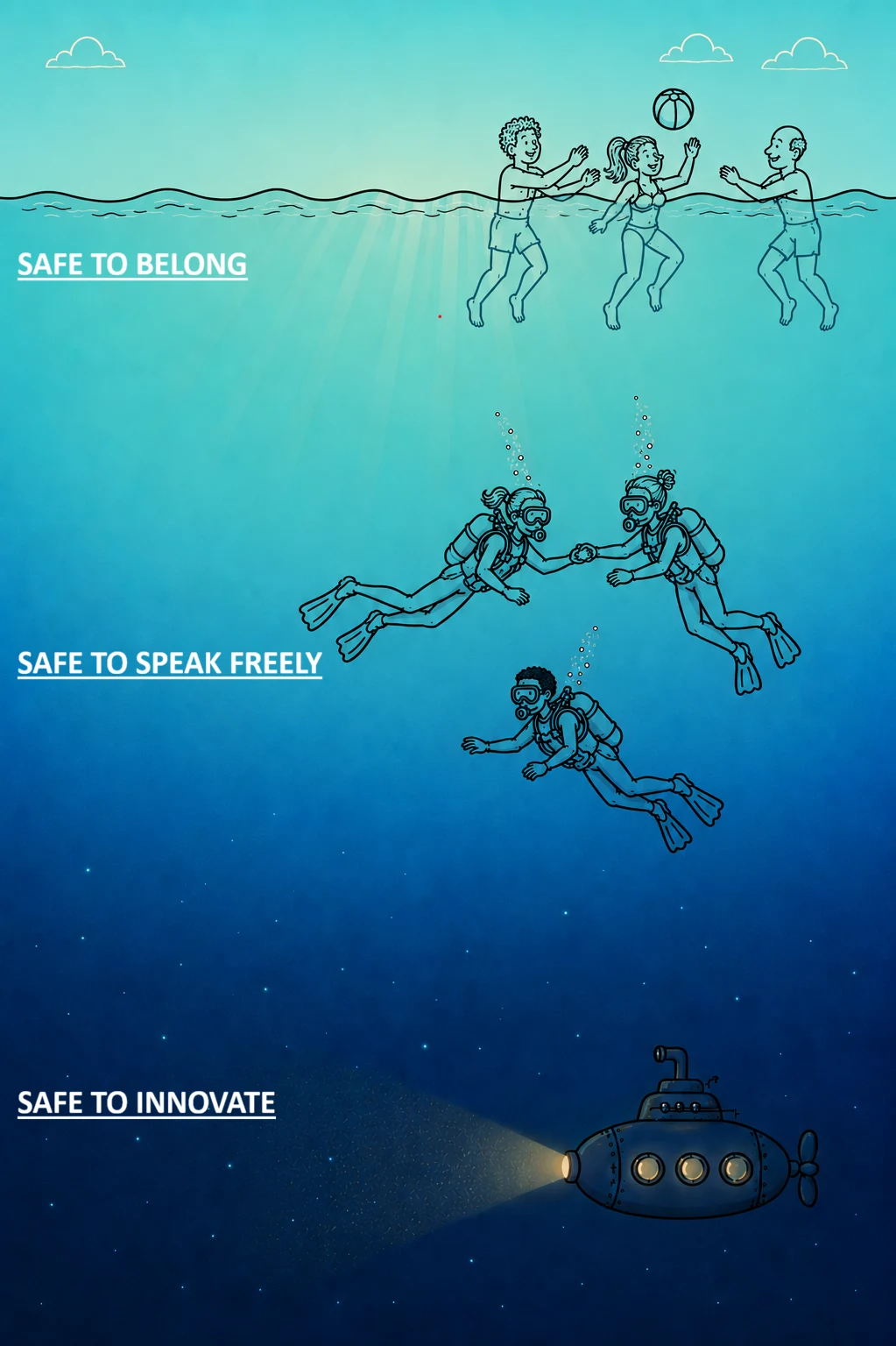
Safety Ocean
Think of psychological safety as a deep ocean. It's easier for teams to feel safe swimming at the surface compared to scuba diving or deep-sea submarine exploration. Teams aiming to perform at the highest level must strive to go deep, where the risk (and reward) is greatest. But there's no point doing that before safety is established in the shallower areas:
- At the surface, Safe to Belong means we are accepted, included, and valued as unique team members.
- In the mid ocean, Safe to Speak Freely means our voices are heard, ideas acknowledged, and problems addressed supportively.
- In the deep ocean, Safe to Innovate means teams learn and experiment, and strive to find better ways of working all the time.
And this can require addressing tensions, limiting beliefs, and establishing new team norms and strategies.
Where is your team in the Psychological Safety Ocean?
Find out how deep your team can safely swim — and where the water gets choppy.
Find out with Otis →When whole teams take surveys, it reveals where they need to focus their efforts to build more psych safety. One of the items from the survey above reads "If I need help from members of this team, I feel comfortable reaching out." If the majority answer "No," or there's a big split among team members, we have a clear area to zero in on. The team objective becomes, "how can we make our team a safe place to reach out for help?" — and the team gets there through jointly identifying strategies and co-creating behavioral agreements.
Constructing New Team Agreements
Psychological safety (or lack thereof) is often obvious when the team is all together. Likewise, it's through inclusive group work, discussions, and co-created agreements that psych safety is best repaired and built.
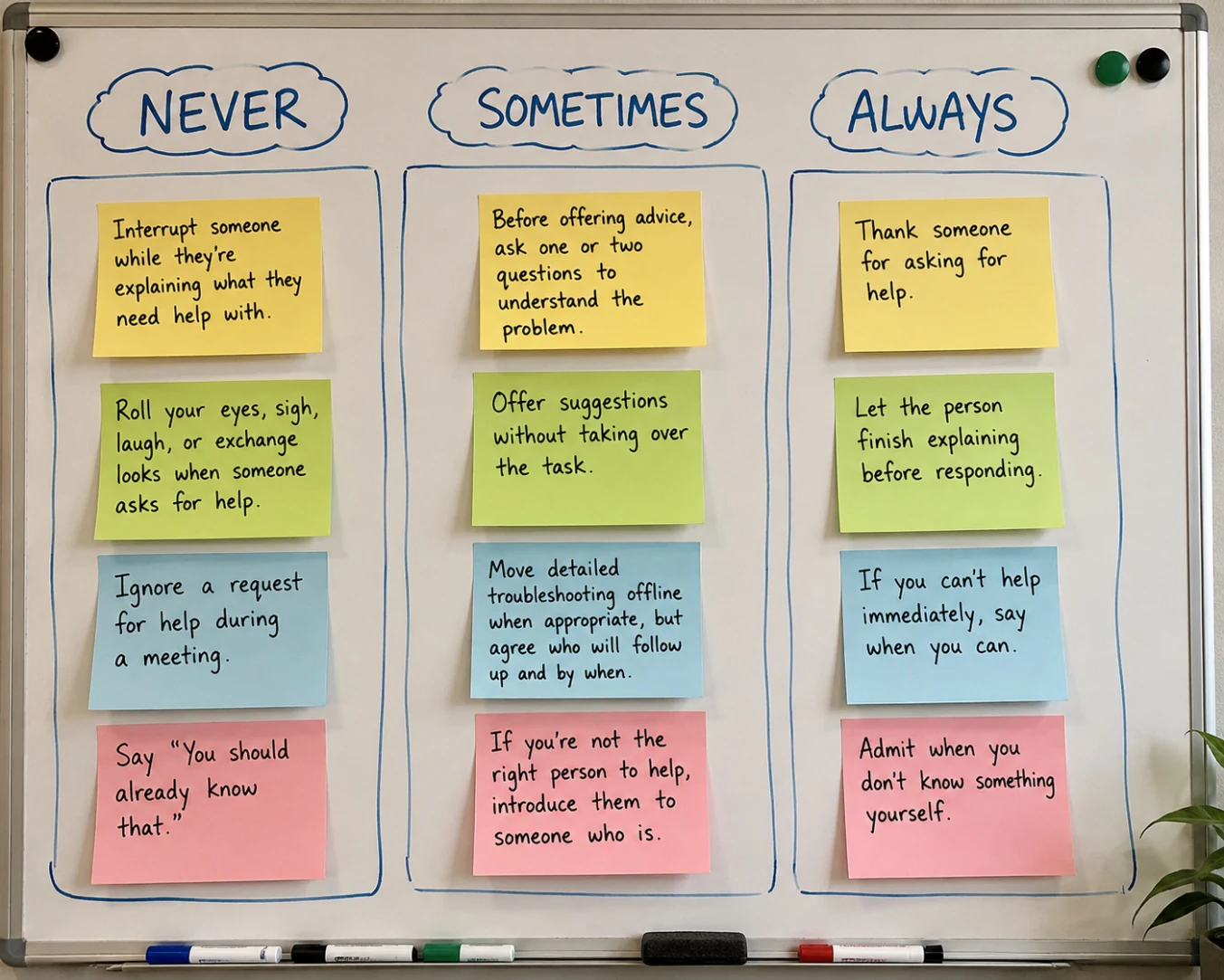
Let's take the example of a team that wants to make it safer for members to ask each other for help, and how they do this through a "Never, Sometimes, Always" exercise. The team brainstorms behaviors they would Never, Sometimes, and Always want to see in response to a teammate asking for help. Behaviors should be observable, not too vague, such as "Be Supportive." A helpful prompt might be: "If I were watching, what exactly would I see or hear?"
 ⤢ Click to enlarge
To establish comfort with the team, this activity can start off as a solo brainstorm, move to paired discussions, and then group comparisons and synthesis of the most significant behaviors. Ideally, the activity ends with the team agreeing to several behaviors they ALWAYS and NEVER want to see, strategies for how to surface these behaviors or address them when someone makes a mistake, and plans for periodic check-ins to sustain momentum in following new codes of conduct.
I built Otis AI (sign up for the beta) to take some of the leg-work out of measuring psychological safety and designing that first structured "Never, Sometimes, Always" conversation and Team Agreement.
Making Use of External Consultants and Facilitators
The more members of a team are accountable for building psychological safety, the better. However, those in leadership positions are best positioned to help teams make this a priority. Yet, few leaders receive coaching on the mindsets, skills, and strategies needed to guide teams in cultivating a psychologically safe culture.
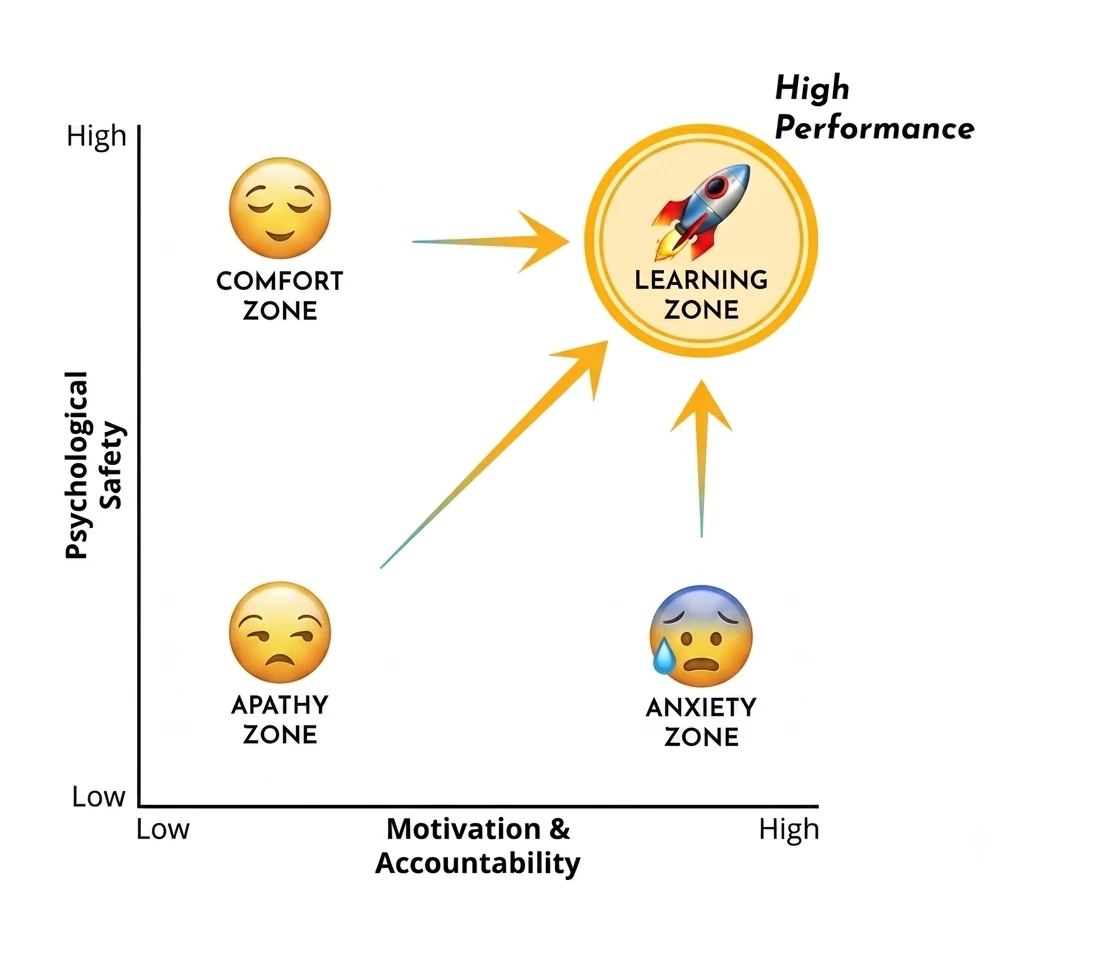
External consultants can help uncover why team performance or engagement is blocked by considering multiple factors. Psychological safety isn't the only element governing team success, as illustrated in the graph. Psychologically safe teams can still perform sub-optimally if members aren't motivated or held accountable (The Comfort Zone). High motivation and accountability without psych safety often result in a stressful, distrusting, high-pressure, low-(interpersonal)-resource environment (The Anxiety Zone). Low motivation and low psych safety get us teams with little engagement or interest in outcomes (The Apathy Zone).
 ⤢ Click to enlarge
The strategies needed to move teams towards the best of both worlds — the Learning Zone — are completely different. "Comfort Zone" teams already have strong psych safety, but need healthy provocation to push them to excel. Those in the "Apathy Zone" often need to rediscover meaning and purpose in their team's work, and may benefit from stronger social bonds and connection along with incentives and motivators. "Anxiety Zone" cases are some of the most formidable, as members may have experienced traumatic events, toxic practices and behaviors, and unsafe organizational cultures that must be addressed before team trust can be rebuilt. External facilitators may be particularly warranted in these cases to help leaders navigate these situations.
Skilled consultants and facilitators will identify the specific needs and blockers of your team, and how to navigate them. The table below provides some additional interventions that consultants might choose from, depending on which "zone" teams start off in.
Many of these draw on established practice: the Five Whys comes from Toyota's production system, blameless post-mortems from software engineering and aviation's just-culture tradition, the "second story" from human-error research, and restorative circles from restorative justice (Edmondson, 2012; Latessa et al., 2023).
Sources
Edmondson, A. C. (2012). Teaming: How organizations learn, innovate, and compete in the knowledge economy. Jossey-Bass/Wiley.
Latessa, R. A., Galvin, S. L., Swendiman, R. A., Onyango, J., Ostrach, B., Edmondson, A. C., Davis, S. A., & Hirsh, D. A. (2023). Psychological safety and accountability in longitudinal integrated clerkships: A dual institution qualitative study. BMC Medical Education, 23, 760. https://doi.org/10.1186/s12909-023-04622-5