
Imagine you’re the head of an insurance company and you’re browsing an enterprise marketplace for Claims Operations SaaS. One option is basically a packaged team of agents, orchestrated to handle customers’ claims. It has fraud specialist agents, a compliance reviewer, a quality agent, an orchestrator, predefined handoffs, escalation rules, and recommended human oversight.
You’ve essentially bought a department of coordinated AI, with predefined roles, hierarchies, and authorities, along with assumptions about how it fits with the work humans are doing, such as insurance adjusters.
That marketplace is hypothetical, but parts of it are already being assembled. Vendors are marketing “job-ready agents” in multi-agent orchestrations. ServiceNow describes an “Autonomous Workforce” of specialist AI, while Workday’s Agent System of Record is designed to govern and measure agents alongside people (Salesforce, 2026; ServiceNow, n.d.; Workday, n.d.).
The Organization Inside the Software
Look at how multi-agent systems are already drawn. Anthropic uses a lead agent that creates specialist subagents. OpenAI’s manager pattern retains control and calls specialists, while its handoff pattern transfers control among peers. AWS shows a supervisor coordinating R&D, legal, and finance agents. Google’s Agent2Agent architecture allows a client agent to discover and work with remote agents across system boundaries (Anthropic, 2025; OpenAI, n.d.; Amazon Web Services, 2025; Google, 2025).
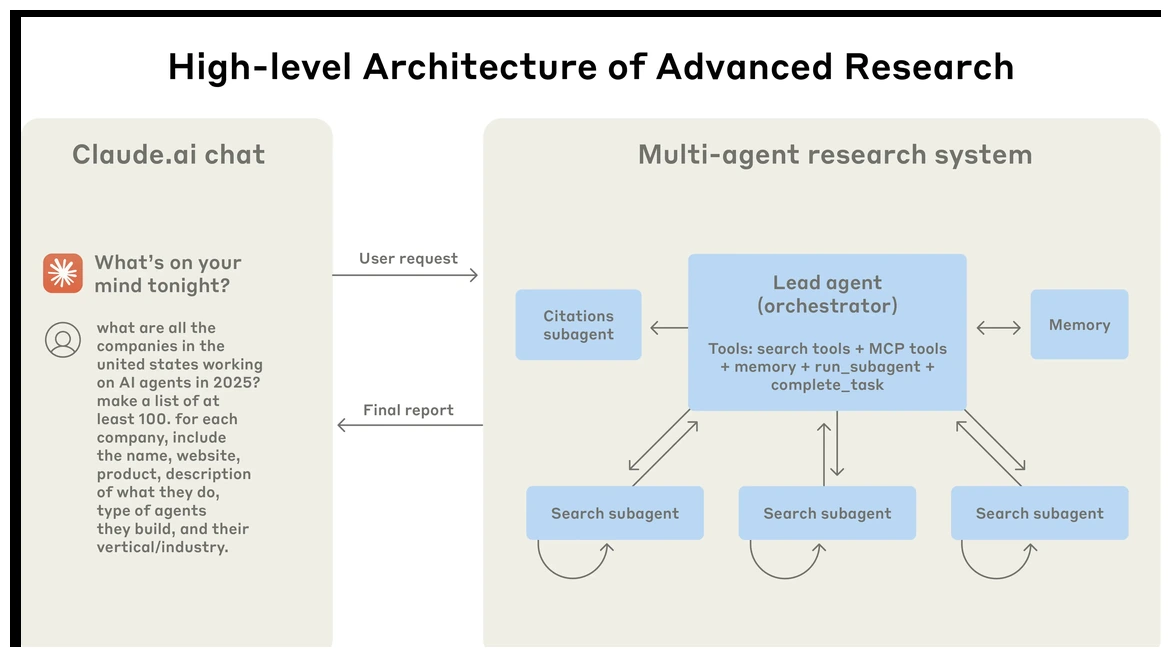
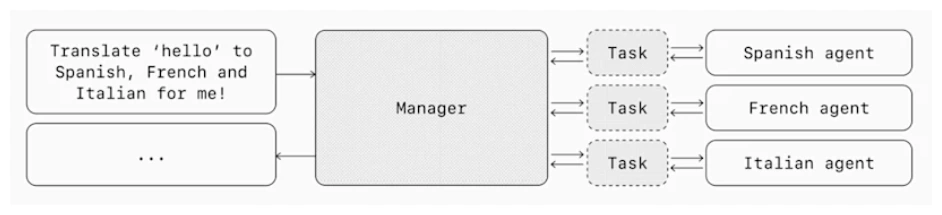
These structures aren’t unfamiliar, right? Even though an agent is not an employee, routing is not leadership, and technical control flow is not the same as accountability, a familiar vocabulary of roles and relationships is emerging. Managers and orchestrators route work among specialists; agents act as guardrails and checkers; and networked systems connect independently built agents across boundaries (Horling & Lesser, 2004).
The Part the Diagrams Underrepresent: The Human
Again, where does the human fit in?
In most diagrams, humans appear as a request, a user icon, a reviewer, or “human in the loop.” That box tells us almost nothing about the job around it. If you integrate ready-made AIs, how will they fit into the human’s context, authority, and expectations?
Let’s imagine an example with our insurance company and Claims Operations package. AI now handles claims below $10,000. A person handles the rest and spends the remainder of their time reviewing scores and metrics of AI’s confidence and reliability. At this point, people’s day-to-day jobs have already changed a great deal.
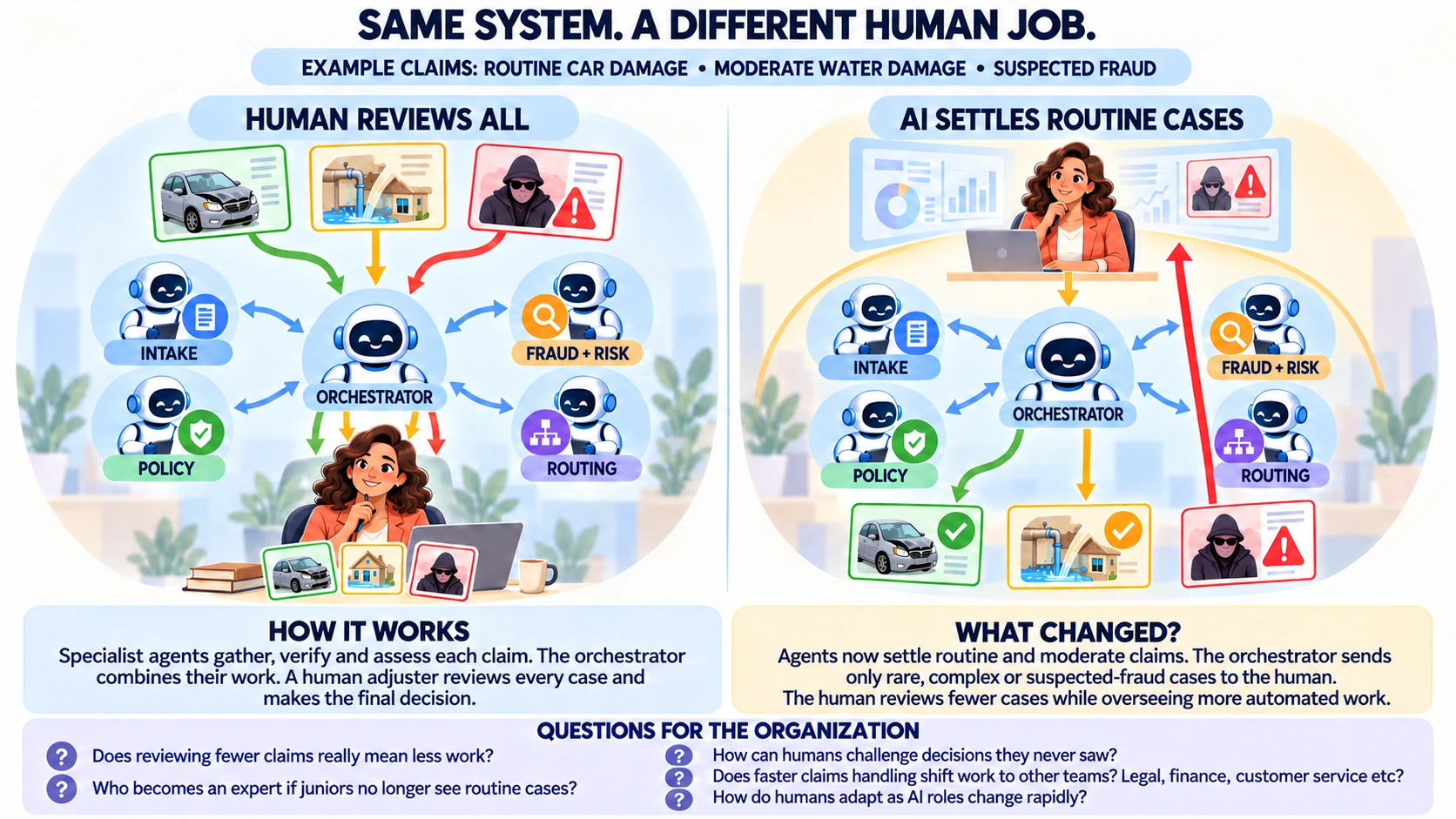
Then, an update to the Claims Operations package raises the threshold that agents can independently handle to $25,000. Humans are now handling only the most high-profile or complex claims, such as suspected fraud. The job has changed once again, with indirect impacts. People see fewer routine cases and more exceptions, and junior employees may lose the cases through which they learn. The relationship with customer service, legal, and finance may change. Perhaps getting claims processed faster means other departments get inundated and can’t keep up. Humans retain authority on paper while exercising it over a smaller share of real decisions.
Refinements to the AI department can therefore become reorganizations of human work. Yet they may arrive as ordinary product updates, without being communicated or governed as organizational change.
What Organizations Should Do
Before deploying a multi-agent system, or approving an update that expands its autonomy, treat the decision as an operating-model change. Conduct an organizational impact review and ask:
- Which decisions can agents make, and where do humans retain effective authority?
- Which work will people stop seeing, and what does that remove from learning and judgment?
- Who inherits the exceptions, new bottlenecks, and cross-functional dependencies?
- How can people challenge decisions they never saw being made?
- What changed since the previous version?
There is no universal human-agent ratio. The right span of control depends on exception volume, risk, reversibility, verification effort, and the context a person must reconstruct before intervening.
Organizations need a living human-agent map connecting tasks, agents, people, work items, documents, messages, users, groups, and projects (Accenture, 2026; Atlassian, 2025). Version that map alongside the software. Give organizational changes their own release notes.
The next enterprise AI decision may not simply be which agent to buy. It may be what organization we are building with it.
Sources
Accenture. (2026). Generating impact: The agentic imperative. https://www.accenture.com/content/dam/accenture/final/accenture-com/document-fy26/q3/Agentic-Imperative-Final.pdf
Amazon Web Services. (2025, June 25). Build an intelligent multi-agent business expert using Amazon Bedrock. https://aws.amazon.com/blogs/machine-learning/build-an-intelligent-multi-agent-business-expert-using-amazon-bedrock/
Anthropic. (2025, June 13). How we built our multi-agent research system. https://www.anthropic.com/engineering/multi-agent-research-system
Atlassian. (2025, November 19). What is Teamwork Graph? https://developer.atlassian.com/platform/teamwork-graph/what-is-teamwork-graph/
Google. (2025, April 9). Announcing the Agent2Agent protocol (A2A). https://developers.googleblog.com/en/a2a-a-new-era-of-agent-interoperability/
Horling, B., & Lesser, V. (2004). A survey of multi-agent organizational paradigms. The Knowledge Engineering Review, 19(4), 281–316. https://doi.org/10.1017/S0269888905000317
OpenAI. (n.d.). A practical guide to building agents. https://openai.com/business/guides-and-resources/a-practical-guide-to-building-ai-agents/
Salesforce. (2026, September 11). Salesforce expands Agentforce with a new portfolio of AI agents built for high-value work. https://www.salesforce.com/news/stories/agentforce-job-ready-ai-agents/
ServiceNow. (n.d.). AI agents. https://www.servicenow.com/products/ai-agents.html
Workday. (n.d.). Workday Agent System of Record. https://www.workday.com/en-us/artificial-intelligence/agent-system-of-record.html